What to inspect on a semi trailer and in what order: brakes, axles, suspension, king pin, landing legs, lights and the frame welds that fail first on bad roads.
Two minutes before moving, every time, in the same order so that nothing gets skipped.
Tyres — pressure by appearance and feel, obvious damage, anything embedded. Wheel nuts — indicator marks aligned, no rust streaking from a nut. Lights — all of them, including the ones you only use in the dark. Coupling — king pin seated, locking jaw closed, safety catch in place. Landing legs — fully up and secured. Load restraint — every strap or chain, tensioned, and every one of them still where you put it. Underneath — any fluid on the ground that was not there yesterday.
The walk-round finds most of what would otherwise become a roadside failure. It is also the only inspection that happens often enough to catch something developing.
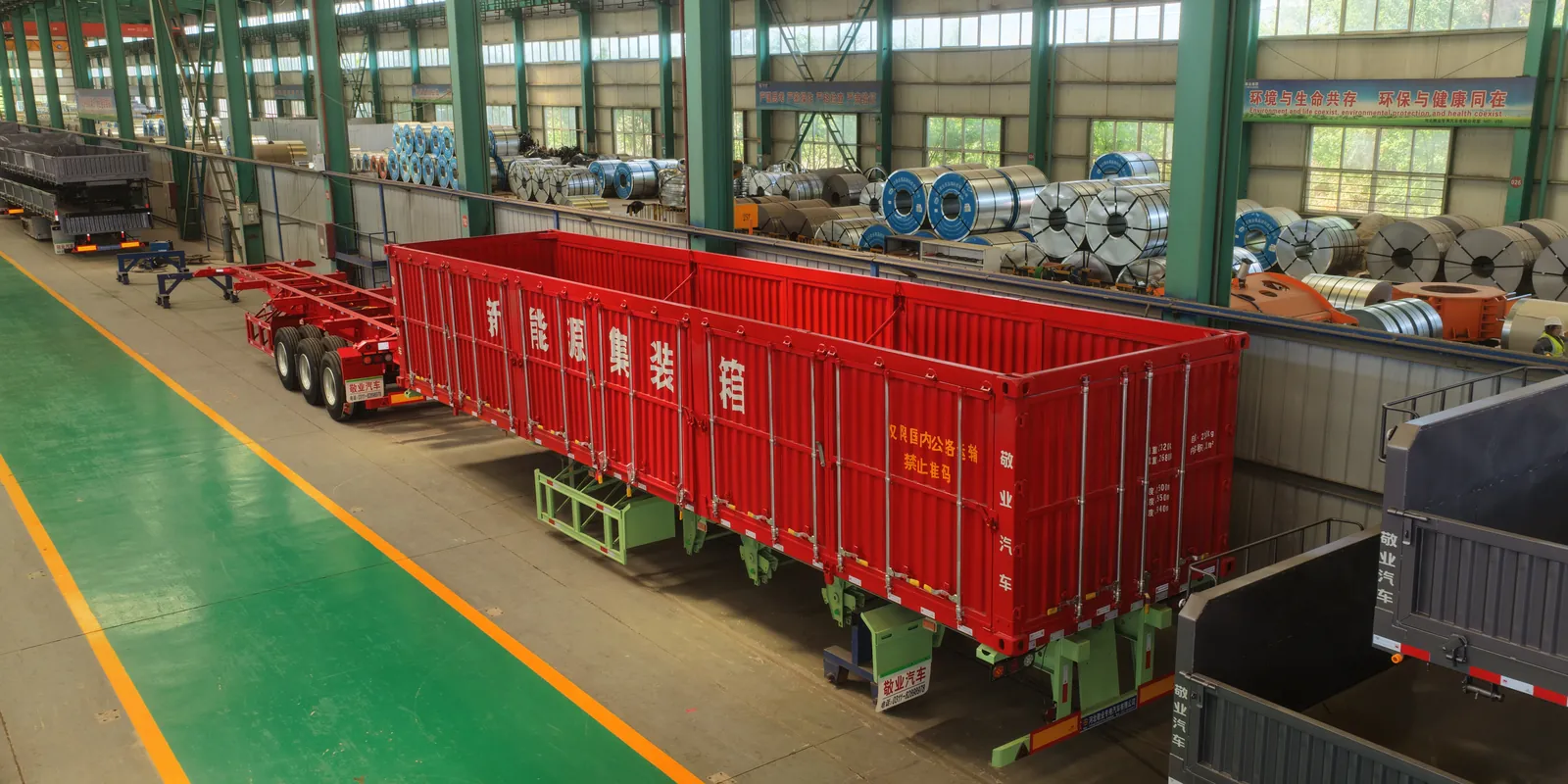
Brakes are the system where deterioration is gradual, invisible from the cab, and total when it arrives.
Linings — thickness against the wear indicator, and evenly worn across the shoe. Uneven wear means something is out of adjustment or something is binding.
Drums or discs — scoring, heat damage, cracking.
Air system — leaks audible with the system charged, and how quickly pressure builds and holds.
Slack adjusters — stroke within limits, and equal side to side. Unequal stroke means unequal braking, which pulls the vehicle under heavy braking.
Hubs — play and roughness in the bearings, seal condition, and whether the hub runs hot after a stretch of road. A hot hub is a bearing telling you it has weeks left.
Leaf packs — cracked or shifted leaves, worn bushes, U-bolt tension. A broken leaf frequently makes no noise and shows up as the vehicle sitting down on one side.
Air bags — chafing where the bag touches anything it should not, cracking in the rubber, and whether the vehicle sits level with the system charged. A bag that is slowly leaking will look fine parked and fail on the road.
Levelling valve and linkage — the ride height is set by a mechanical linkage that gets knocked. If the vehicle rides low or high, check the linkage before you suspect the bags.
Shock absorbers — leaks, and whether they still damp. Failed shocks let the suspension work harder and shorten everything else's life.
King pin — wear measured against the manufacturer's gauge, not by eye. A worn pin is not an inconvenience; it is the single connection between the trailer and the tractor.
Fifth wheel plate on the trailer side — flat, greased, and free of the scoring that comes from running dry.
Landing legs — wind up and down through the full range, both speeds, checking the cross shaft and the gearbox. Feet undamaged and sitting flat. Legs are neglected because they are only used stationary, and they are what fails at the worst possible moment: with a loaded trailer standing on them.
On bad roads the frame fails before anything else, and it fails at predictable places.
Where the suspension mounts to the main beam. Every road input arrives here.
Around the king pin plate. Traction and braking loads concentrate at this point.
At any change of section. A gooseneck step, the end of a reinforcement, a crossmember junction — anywhere the geometry changes is where stress concentrates.
Around cut-outs. Anything cut into a beam for access or lightness is a stress raiser.
Look for paint cracking in a straight line, rust staining from a seam that should be sealed, or a weld with a visible line along its toe. Cracks found early are a repair; cracks found late are a frame.
A note on what this section is and is not. Below is a list of the components that wear out, based on what fails on this type of vehicle. It is not a parts catalogue and it is not a supply commitment — we do not currently hold a stocked parts operation outside China, and we are not going to imply one here.
What wears out, roughly in order of how often: brake linings; air bags and air lines; shock absorbers; wheel bearings and hub seals; suspension bushes; leaf spring U-bolts; landing leg gearboxes; lighting units and wiring looms; king pin and fifth-wheel wear components; mudguards and their brackets.
What is worth holding locally rather than ordering: anything that stops the vehicle and is cheap — lighting, air lines, bushes, U-bolts. What is not: anything expensive that fails with warning, which is most of the rest.
If you are building a stocking list for a fleet, tell us the fleet size and the duty and we will go through it with you. What we can supply and how quickly is a conversation to have honestly rather than a promise to make on a web page.