





The main parts of a semi trailer are the coupling, the frame, the running gear, the brakes, the lights and guards, and the body. Below is what each part is called and what it does, which helps when you compare quotations, read a specification sheet or talk to your workshop.

1. The coupling: king pin and connections
King pin. A steel pin under the front of the trailer. It locks into the fifth wheel on the tractor, and it is the only mechanical connection between the two. Every pulling and braking force passes through it.
King pin plate. The flat plate around the king pin that rests on the fifth wheel. The fifth wheel itself belongs to the tractor, not the trailer.
Air and electrical connections. Couplings at the front of the trailer link it to the tractor’s air brake system and electrical system. The air lines operate the trailer brakes; the electrical connection powers the lights. The type of connector varies by market, so confirm that the trailer matches the tractors you run.
2. Landing gear
The landing gear, also called landing legs, holds up the front of the trailer when it is uncoupled from the tractor. It is wound up and down with a handle, usually through a gearbox with a fast speed and a slow speed, and a cross shaft links the two legs so they move together.
Landing legs are used only when the trailer is parked, so they are easy to neglect. But they hold up a loaded trailer when it stands on its own. Check them on every service.
3. The frame
Main beams. Two long beams running the length of the trailer. Everything else is attached to them. On heavy trailers they are usually fabricated I-sections, with the steel thickness chosen for the duty.
Cross members. Shorter members running across between the main beams. They tie the beams together and support the deck or body.
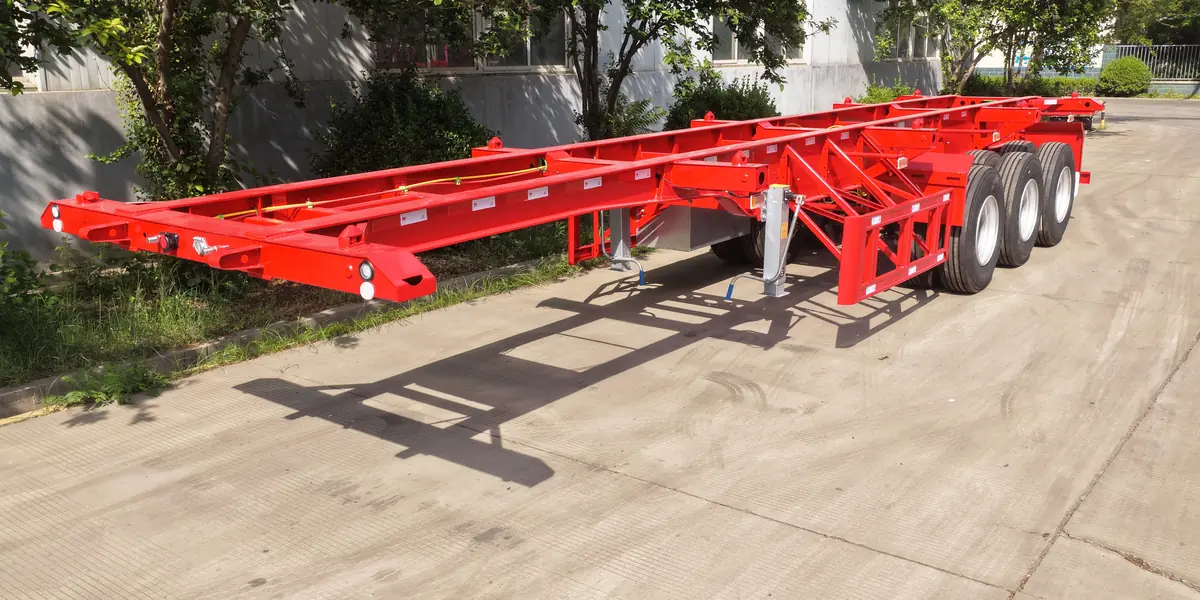
Gooseneck. Some trailers step the main beams down behind the king pin. This lowers the deck or the load. It is common on container chassis, where it helps keep the loaded height down.
4. Running gear: axles, suspension, wheels
Axles. Most heavy semi trailers run two or three axles grouped at the rear. Each axle has a rated load, and the spacing between axles affects how the load is spread and what the trailer is allowed to carry on the road in a given country.
Suspension. The suspension connects the axles to the frame. There are two main types:
- Leaf spring (mechanical) suspension carries the load on stacked steel leaves. It is simple, tolerant of rough use and easy to repair almost anywhere.
- Air suspension carries the load on air bags. It gives a smoother ride, shares the load more evenly between axles and lets you adjust ride height, but it adds a system of bags, valves and lines to maintain.
We compare the two in more detail in our guide to trailer air-ride suspension.
Wheels, tyres and hubs. The wheels turn on hubs fitted with bearings and seals. Tyre size and the number of tyres per axle are part of the trailer’s specification. Check them against what your local tyre suppliers stock.
5. Brakes
Semi trailer brakes are operated by air. The main parts you will hear named are:
- Brake chambers, which turn air pressure into movement;
- Slack adjusters, which link the chamber to the brake and keep the stroke correct;
- Drums and linings (or, on some trailers, discs and pads), where the braking actually happens;
- Air tanks and valves, which store air on the trailer and control how it is applied.
Brakes wear gradually and the driver cannot see them from the cab, so they belong on every regular inspection.
6. Lights and guards
Lights and reflectors. Rear lights, side marker lights and reflectors, powered through the electrical connection to the tractor. Which lights are required, and where, depends on local road rules.
Mudguards. Fitted over the wheels to stop spray and stones.
Side guards and rear bumper. Guards along the sides and a bar at the rear help stop smaller vehicles from running under the trailer in a collision. Whether they are required, and to what standard, depends on the market.
7. The body: what changes from trailer to trailer
The parts above are common to most semi trailers. The body is what sets one type apart from another:
- A flatbed semi trailer has an open deck with lashing points for securing the load.
- A container chassis has no deck at all, just twist locks at the positions where a container’s corners sit.
- A dropside trailer has side panels that come off or fold down for loading.
- A fence semi trailer has tall lattice sides for light, bulky loads.
- A side tipper has a tipping body and hydraulic cylinders that lift it to discharge sideways.
- A dry van trailer has a fully enclosed body with rear doors.
- A steel coil trailer has a recessed well and anti-sway clamps to hold coils in place.
For a fuller picture of the main categories, see our guide to types of semi trailers.
Which parts wear out
Some parts wear out faster than others: brake linings, air bags and air lines, shock absorbers, wheel bearings and seals, suspension bushes, landing leg gearboxes, lights and wiring, and mudguards. Our semi trailer maintenance guide covers what to check on each, and where frames tend to crack.
We build complete trailers. We do not hold a stocked parts operation outside China, so for a replacement part on a trailer you already run, a parts dealer in your region will usually be the quicker source. If your load needs a lowered deck or ramps to drive on, that is a low-bed trailer, which we do not currently offer.
A part on a quotation you are not sure about?
If a part named on a quotation or specification sheet is unclear, contact us and ask. Our engineers reply within 24 hours.
Email: info@jy-trailer.com
WhatsApp: Manager Tan +86 150 2773 4701 · Manager Zhang +86 185 0327 0573 · Manager Liu +86 189 2375 2006 · Manager Peng +86 185 3334 5708
HEBEI JINGYE SPECIAL VEHICLE CO., LTD.