Every dimension, weight and volume you need to plan a load: internal and external sizes, tare and payload, CBM, and a calculator that does the arithmetic.
Container dimensions come in two sets, and mixing them up is the most common planning error in this market.
External dimensions are standardised. They are fixed by ISO 668 so that a box built anywhere fits a ship, a chassis and a crane built anywhere else. A 20-foot box is 20 feet externally, everywhere, always.
Internal dimensions are not. They depend on the wall build-up, the corrugation profile and the floor of the individual box, and they vary between manufacturers by enough to matter when you are counting pallets.
Plan loads on internal figures — and take them from the box you are actually buying, not from a generic table.
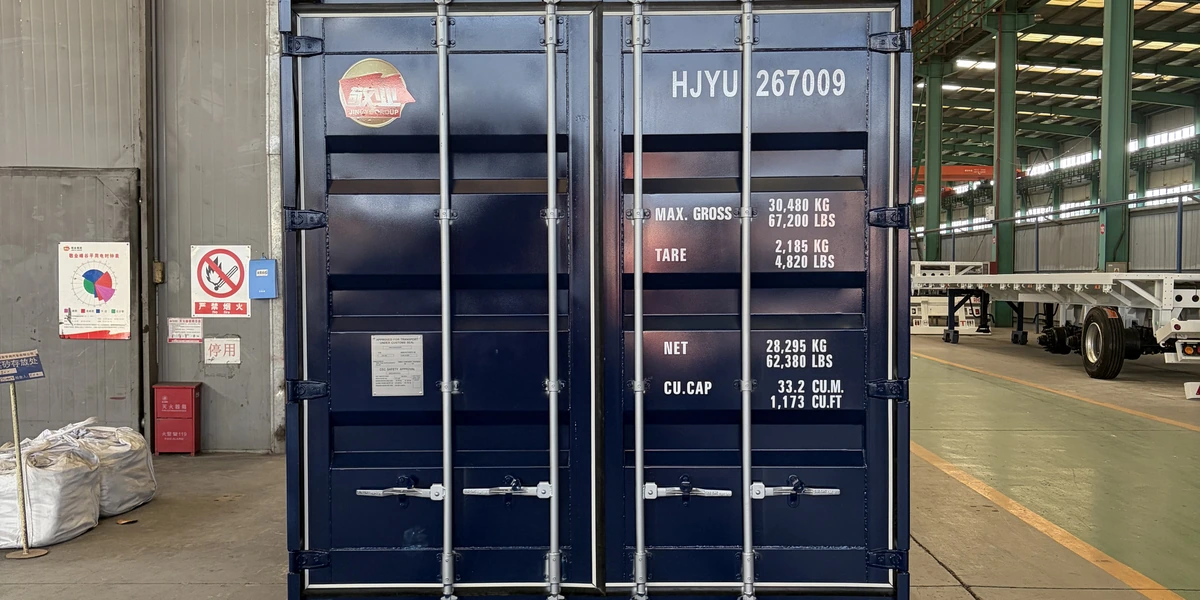
Three weights, and every one of them appears on the CSC plate.
Tare is the weight of the empty box. Payload — sometimes written as net or max cargo weight — is the most you may load into it. Gross is the two added together: the maximum the box may weigh when full.
The number that catches people out is not on the plate at all: your road limit. A container may be legally loaded to its gross rating and still be illegal on the vehicle carrying it, because the vehicle has its own axle limits. The container’s limit and the road’s limit are different constraints and the lower one wins.
Cubic capacity is internal length × internal width × internal height, and for a 20-foot general purpose box it comes to 33.2 m³.
That figure is a ceiling, not a forecast. What you actually load depends on how your cartons stack: any dimension that does not divide neatly into the internal space leaves a gap, and the gaps compound. A carton plan that wastes 8 cm of height on each of six layers has lost half a metre of box.
Working that out by hand is tedious and easy to get wrong, which is what the calculator is for.
Dimensions, cubic capacity and tare for 40-foot and 40-foot high cube boxes are set out separately. Load planning needs them often.
They are reference figures. We build the 20 ft box.
Enter your carton dimensions and quantity and the calculator returns how many fit in a 20 ft, 40 ft or 40 HC box — by volume and by weight — and flags which of the two limits you hit first.
That last part matters. Half of container planning problems are people optimising volume when weight was going to stop them, or the reverse.