One table with internal and external length, width and height, door opening and cubic capacity for 20 ft, 40 ft and 40 HC — in metres and in feet and inches.
Internal dimensions are the ones you load into, and they are the ones that vary.
Two boxes with identical external dimensions can differ inside by several centimetres, because wall build-up, corrugation profile and floor thickness are the manufacturer's choices rather than the standard's. The difference is small in absolute terms and large in practice: a few centimetres of internal height is a whole layer of cartons.
The table below gives typical internal figures for the three common formats. For a load plan you are committing to, use the figures for the box you are actually buying.
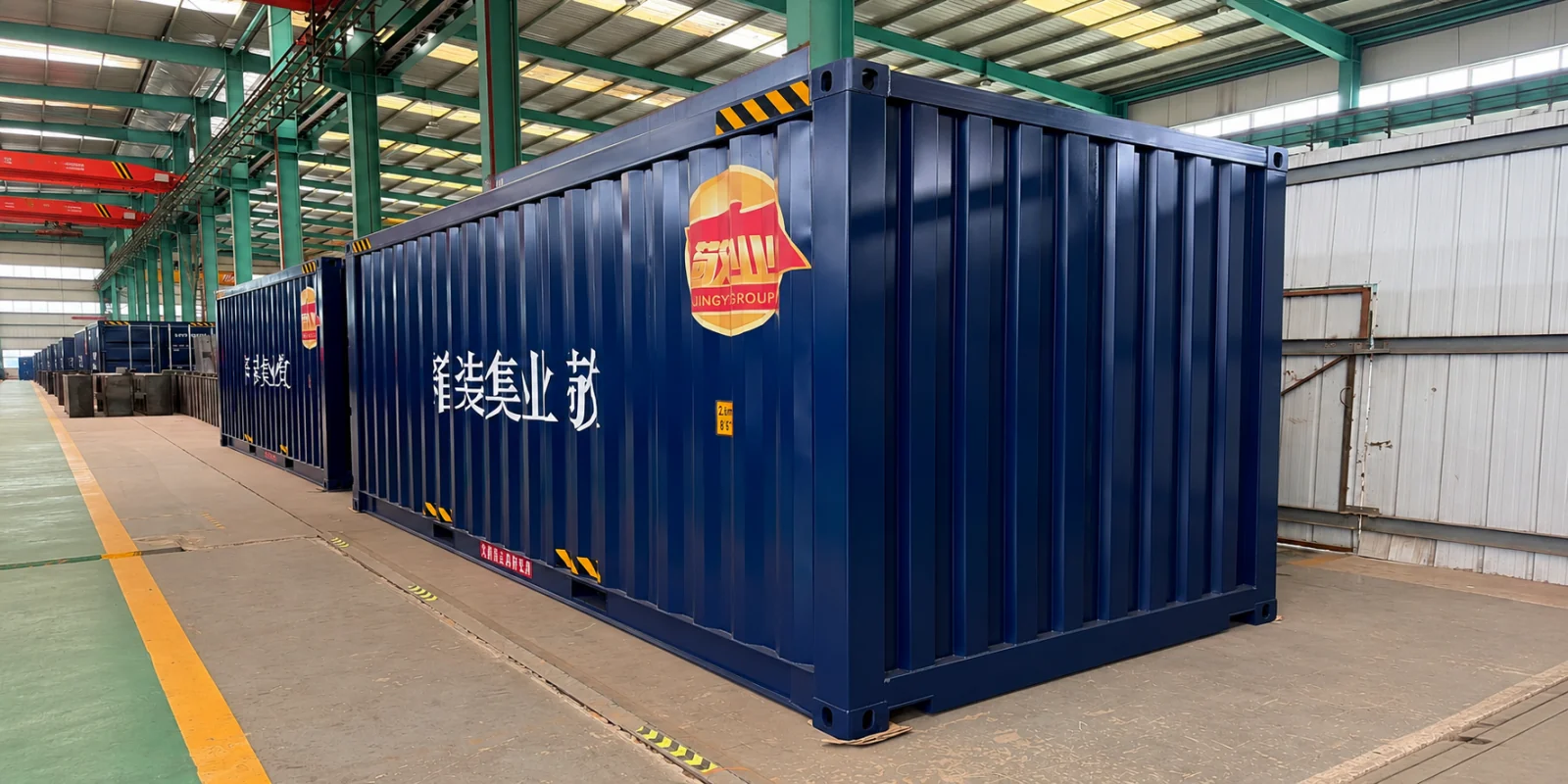
Our own 20 ft box gives 33.2 m³ internal.
| Container | Length | Width | Height | Capacity |
|---|---|---|---|---|
| 20 ft GP (1CC) | 5,898 mm | 2,352 mm | 2,393 mm | 33.2 m³ |
| 40 ft GP (1AA) | 12,032 mm | 2,352 mm | 2,393 mm | 67.7 m³ |
| 40 ft HC (1AAA) | 12,032 mm | 2,352 mm | 2,698 mm | 76.4 m³ |
Source: ISO 668. The standard fixes external dimensions and maximum gross mass exactly. Internal length, width, height and capacity are nominal, and they differ from manufacturer to manufacturer.
External dimensions are fixed by ISO 668 and do not vary. That is the entire point of containerisation: a box built anywhere fits a ship, a chassis, a crane and a stack built anywhere else.
Use these when you are working out whether a box fits somewhere — a yard, a chassis, a doorway, a permit envelope. Never use them to plan what goes inside it.
| Container | Length | Width | Height | Max gross |
|---|---|---|---|---|
| 20 ft GP (1CC) | 6,058 mm | 2,438 mm | 2,591 mm | 30,480 kg |
| 40 ft GP (1AA) | 12,192 mm | 2,438 mm | 2,591 mm | 30,480 kg |
| 40 ft HC (1AAA) | 12,192 mm | 2,438 mm | 2,896 mm | 30,480 kg |
Source: ISO 668, exact. Maximum gross mass sits in this table rather than the internal one because it is the other figure the standard pins down — 30,480 kg for all three formats, whoever built the box.
The door opening is smaller than the internal cross-section, and it is what actually limits what you can get in.
A box can have ample internal height and a door frame that will not take your tallest item. This catches out anyone loading machinery, palletised goods stacked to full height, or anything rigid and awkward.
Check the door opening height and width before you check anything else, because everything else is irrelevant if the load will not go through the door.
| Container | Width | Height |
|---|---|---|
| 20 ft GP (1CC) | 2,340 mm | 2,280 mm |
| 40 ft GP (1AA) | 2,340 mm | 2,280 mm |
| 40 ft HC (1AAA) | 2,340 mm | 2,585 mm |
Source: ISO 668, nominal. Door width and height move with each manufacturer’s frame, hinge and gasket detail. If your load comes within about 50 mm of these figures, measure the doors before you plan around them.
Cubic capacity is internal length × width × height. It is a ceiling, not a forecast.
What you actually achieve depends on how your cartons divide into the internal space. Gaps compound: a plan that wastes a few centimetres on each of several layers loses a substantial fraction of the box. The calculator works this out properly.
Both systems are in daily use in this trade and mixing them is a real source of error. Metres and millimetres are standard in most of the world; feet and inches remain standard in North American documentation and in the format names themselves — a "20 ft" box is named in feet and specified in millimetres.
The table gives both. Where a converted figure has been rounded, it is rounded down, so that a load that fits on paper fits in the box.
| Container | Length | Width | Height | Capacity |
|---|---|---|---|---|
| 20 ft GP (1CC) | 5,898 mm / 19 ft 4 in | 2,352 mm / 7 ft 8 in | 2,393 mm / 7 ft 10 in | 33.2 m³ / 1,172 cu ft |
| 40 ft GP (1AA) | 12,032 mm / 39 ft 5 in | 2,352 mm / 7 ft 8 in | 2,393 mm / 7 ft 10 in | 67.7 m³ / 2,390 cu ft |
| 40 ft HC (1AAA) | 12,032 mm / 39 ft 5 in | 2,352 mm / 7 ft 8 in | 2,698 mm / 8 ft 10 in | 76.4 m³ / 2,698 cu ft |
Source: ISO 668, both columns. The imperial figures are converted from the metric ones and inherit the same status: exact on the outside of the box, nominal on the inside, where manufacturers differ.