Tare, payload and gross weight for 20 ft, 40 ft and 40 HC boxes — what each figure means on the CSC plate and which one your road limit actually cares about.
Every container carries a CSC Safety Approval Plate, and the three weights that matter are stamped on it.
TARE — the weight of the box empty.
MAX. GROSS — the most the box may weigh loaded.
NET / PAYLOAD — gross minus tare: the most cargo you may put in.
Read them off the plate of the box you are loading rather than from a table. Tare varies between manufacturers and between build years by enough to matter at a weighbridge, and a box that has been repaired weighs more than it did when it was built.
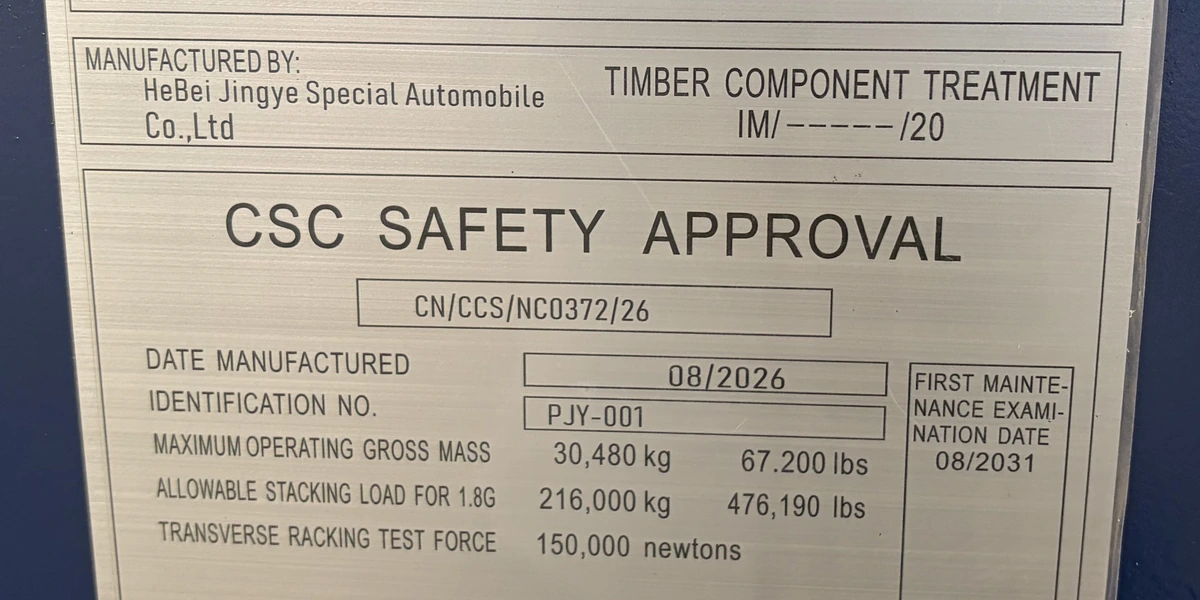
For our 20 ft general purpose box the payload figure is 28,295 kg.
That is a large number relative to the internal volume of 33.2 m³, and it is why 20-foot boxes are the format for dense cargo. Load steel, tiles, minerals or machinery parts and you will reach the weight limit with the box far from full — which is exactly what you want, because you are paying for one slot rather than two.
Cargo that fills before it weighs is the opposite case, and belongs in a 40-foot box.
The 28,295 kg above is ours — the payload of the box we build, with a 28 mm floor under it. ISO 668 fixes only the 30,480 kg maximum gross mass; the 2,185 kg between that ceiling and our payload is the tare of our own box, and another manufacturer’s box lands somewhere else.
Reference figures. We build the 20 ft box.
A 40-foot box weighs more empty than a 20-foot box but not twice as much, and its payload rating is not twice as high either. A high cube is heavier again than a 40-foot standard, because there is more steel in the walls — and that extra tare comes directly out of payload if you are running to a gross limit.
The practical consequence: doubling the length does not double what you can load by weight. It roughly doubles what you can load by volume. Whether that is a good trade is decided entirely by the density of your cargo.
| Container | Maximum gross mass |
|---|---|
| 20 ft GP (1CC) | 30,480 kg (67,200 lb) |
| 40 ft GP (1AA) | 30,480 kg (67,200 lb) |
| 40 ft HC (1AAA) | 30,480 kg (67,200 lb) |
Source: ISO 668, exact. One ceiling for all three formats. Tare is not standardised — it differs from manufacturer to manufacturer, and from box to box once repairs and fittings are counted — so payload, which is gross minus tare, is a figure each box carries and no table can.
A container's gross rating and your road limit are two separate constraints, and the lower one wins.
The container's rating says what the box can structurally take. Your road limit says what the axle configuration underneath it may legally weigh on your route — and it is set by the country you are in, not by anything on the box.
The failure mode is specific and common: a box loaded to its full gross rating, on a chassis and tractor that are then overweight on the axles. The box is legal. The vehicle is not. And it is the vehicle that gets stopped.
Work backwards from your axle limits, not forwards from the container plate.