





How much does a 20ft shipping container weigh? The 20 ft dry cargo container we build weighs 2,185 kg empty, and the most it may weigh when loaded is 30,480 kg. The gap between those two figures, 28,295 kg, is the cargo you are allowed to put inside.
Those three numbers are what you need to book transport and plan a load. Each one has a name, and each is painted on the door of the box.
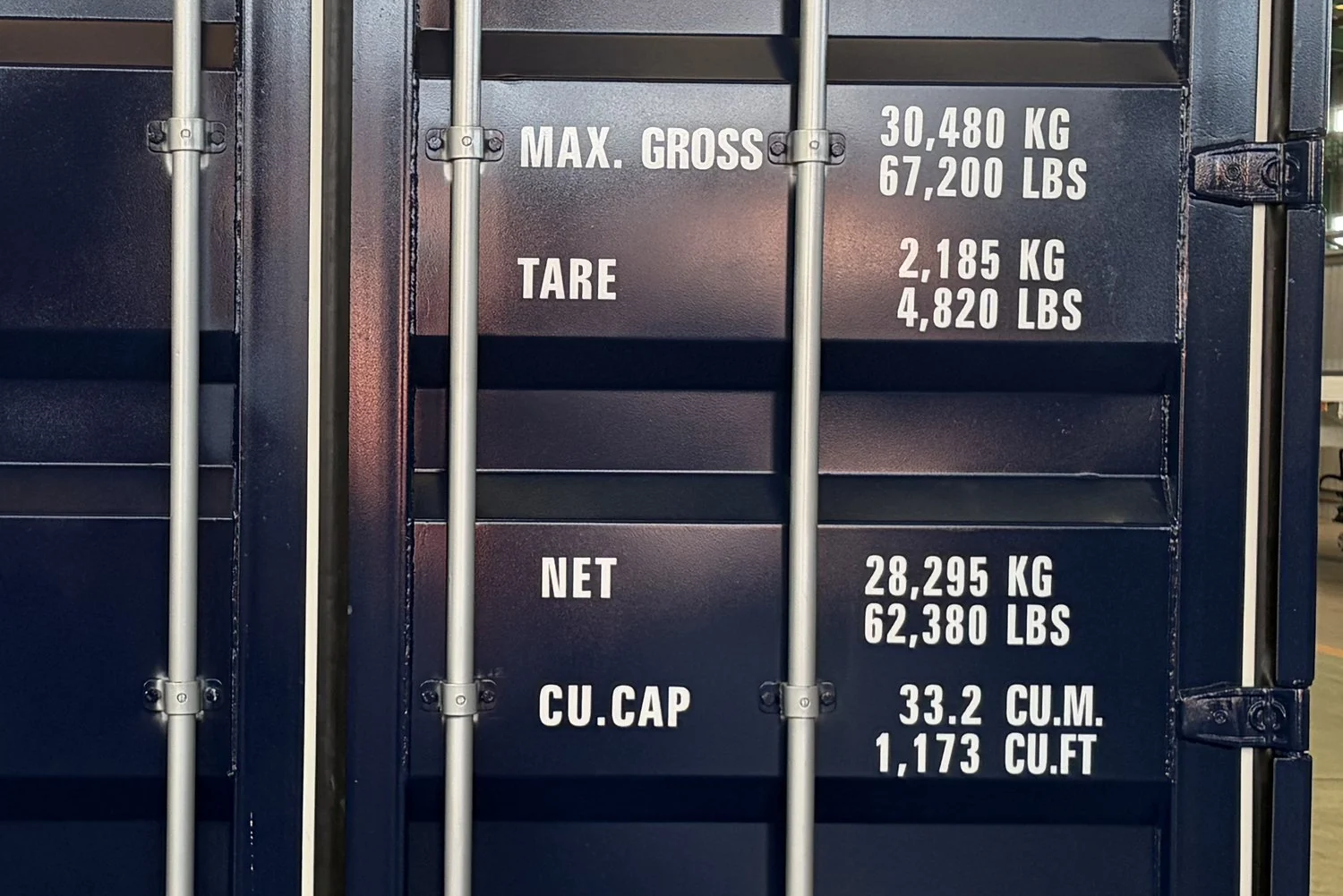
The three weights on every container
Tare is the weight of the empty box. On our 20 ft dry container it is 2,185 kg (4,820 lb).
Maximum gross is the most the box may weigh with cargo in it. For a 20 ft box it is 30,480 kg (67,200 lb), the ceiling set by ISO 668.
Payload, marked NET on the door, is maximum gross minus tare. On our box that leaves 28,295 kg (62,380 lb) for cargo.

We explain how the three relate, and what they mean on the road, in our guide to container tare, payload and gross weights.
Why the empty weight differs from box to box
ISO 668 fixes the maximum gross. It does not fix the tare. The empty weight depends on how the box is built: the steel in the panels and frame, the floor, and the paint. Ours has 2.0 mm weathering steel side and end panels, 5 mm corner posts and a 28 mm floor.
Another manufacturer’s 20 ft box will land somewhere else, and a box that has been repaired weighs more than it did when it left the factory. Read the tare off the box you are loading. A figure from a table is only a starting point.
Where to read the weights on a box
The weights are stencilled on the right-hand door: MAX. GROSS, TARE and NET, each in kilograms and pounds, with the cubic capacity underneath.
The CSC safety approval plate on the door carries the maximum operating gross mass too, along with the stacking and racking test values. If the door marking and the plate disagree on the maximum gross, ask the seller before the box ships. Our article on what a CSC plate is walks through the plate line by line.
Why a 20 ft box suits heavy cargo
Our 20 ft box holds 33.2 m³. With 28,295 kg of payload against that volume, dense cargo such as steel, tiles, minerals or machinery parts reaches the weight limit long before the box is full.
That is the job a 20 ft box does well. Cargo that fills the space before it gets heavy belongs in a 40 ft box. The internal dimensions of ours are on our 20 ft shipping container page.
How much does a 40 ft container weigh?
ISO 668 gives a 40 ft box and a 40 ft high cube the same 30,480 kg maximum gross as a 20 ft box. A 40 ft box weighs more empty, though not twice as much, so its payload is lower than a 20 ft box’s at the same ceiling. A high cube has more steel again, which comes straight out of payload.
We build the 20 ft box only. If you need a 40 ft or high cube container, a container depot or trader is the right place to buy it. Our standard container dimensions page has reference figures for both.
The box rating is not your road limit
The 30,480 kg on the door says what the box can structurally carry. What you may put on the road is set by the axle limits of the country you drive in, for the chassis and tractor underneath.
A box loaded to its full rating can leave the truck over the limit even though the box itself is legal. Work out your load from your axle limits first.
Ask for the figures of your build
If you are ordering 20 ft containers and need the tare and payload for your exact specification, contact us. Our engineers reply within 24 hours.
Email: info@jy-trailer.com
WhatsApp: Manager Tan +86 150 2773 4701 · Manager Zhang +86 185 0327 0573 · Manager Liu +86 189 2375 2006 · Manager Peng +86 185 3334 5708
HEBEI JINGYE SPECIAL VEHICLE CO., LTD.