ISO 668 sets the sizes; ISO 6346 sets the markings. How to read an owner prefix, a check digit and a size-type code off the door of any shipping container.
ISO 668 is the standard that makes containerisation work. It fixes the external dimensions and the maximum gross mass of freight containers, so that a box built anywhere fits a ship, a chassis and a crane built anywhere else.
What it standardises is the outside, not the inside. External length, width and height are fixed; internal dimensions vary with the wall and floor construction of the individual box, which is why two containers with identical external dimensions can differ in internal volume.
This is the single most useful thing to understand about container specifications: the outside is standard and the inside is not. Plan a load on internal figures, and get the internal figures for the box you are actually buying.
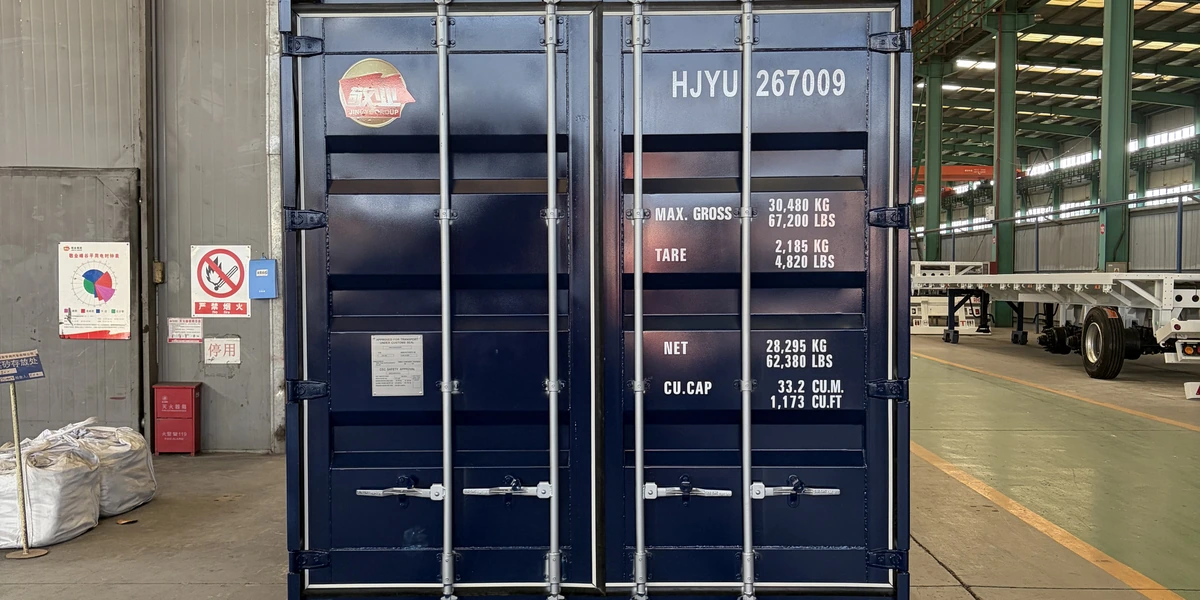
ISO 6346 governs the markings. Every container carries an identification of exactly eleven characters, and it is built the same way everywhere.
Four letters. The first three are the owner code, allocated to the container’s owner or operator. The fourth is the category identifier — U for a freight container, which is what almost all of them are.
Six digits. The serial number, assigned by the owner.
One digit. The check digit, which is calculated from the ten characters before it.
That is the string you quote when you are talking about one specific box, and it is what appears on every document that box travels with.
Separately from the identification, a container carries a four-character size-type code.
The first character is length, the second is height and width, and the last two describe the type. Once you know the pattern you can read any box off the door: 22G1 is a 20-foot general purpose container at standard height, 42G1 is the 40-foot equivalent, 45G1 is a 40-foot high cube.
The commercial shorthand — 20GP, 40GP, 40HC — maps onto these codes and is what most people actually use in correspondence. Both are correct; the ISO code is what appears on the box.
The check digit is a modulus calculation over the four letters and six digits. Each character is converted to a value, weighted by its position, summed, and reduced.
Its purpose is to catch transcription errors, and it does. A number that fails the check has almost always been mistyped somewhere between the yard and the paperwork — a transposed pair of digits, or a letter read wrong on a weathered door.
Two practical consequences. If a container number fails validation in your system, the box is not fake; someone has typed it wrong. And it is worth validating numbers at the point they are entered rather than discovering the problem when a bill of lading does not match a customs declaration.
The CSC plate — the Safety Approval Plate required by the International Convention for Safe Containers — is a separate thing from either standard above, and buyers routinely conflate them.
ISO 668 and ISO 6346 are dimensional and identification standards: they say what size the box is and what it is called. The CSC plate is a safety approval: it certifies that the box has been built or examined to a standard that makes it safe to stack, lift and carry, and it carries the approval reference and the next examination date.
A box without a valid CSC plate cannot legally move in international transport. That is why it is the compliance document that matters for a container, and why we plate every box we build before it leaves.