Why containers are built from weathering steel, what Q355GNHJ is, and how the panel, the coating and the 28 mm floor decide how long a box lasts at sea.
Weathering steel — Corten is the best-known trade name — does not resist rust. It rusts deliberately, and then stops.
Small additions of copper, chromium, nickel and phosphorus change what the corrosion product does. On ordinary structural steel, rust is porous: it flakes, exposes fresh metal underneath, and the process continues until there is nothing left. On weathering steel the first layer of oxide is dense and adherent, and it seals the surface against the oxygen and moisture that would drive further corrosion.
The result is a stable patina rather than progressive loss of section. For a container — an asset that spends its life outdoors, in salt air, with no realistic prospect of being repainted on schedule — that is exactly the right behaviour.
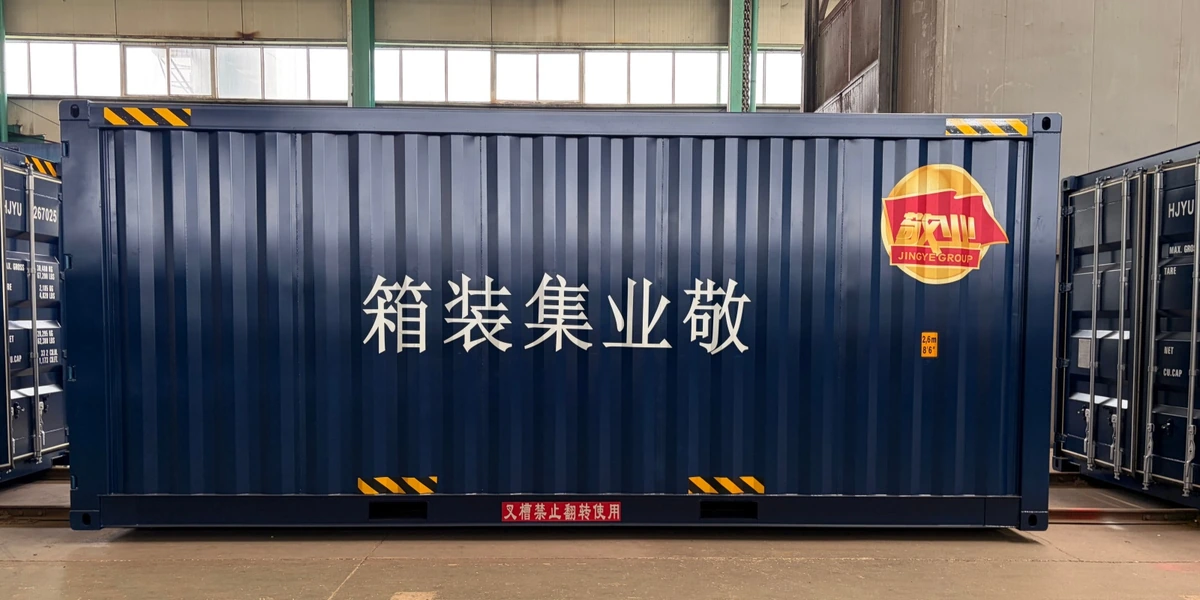
The panel grade we use is Q355GNHJ: a Chinese weathering structural steel, 355 MPa minimum yield, in the atmospheric-corrosion-resistant series.
Two properties matter for a box. The yield strength is what lets a corrugated panel be thin and still stiff — the corrugation does the structural work, and the steel has to hold the shape. The weathering behaviour is what keeps that thin panel intact over a service life measured in decades rather than years.
Corrugation depth and pitch are part of the same calculation. A deeper corrugation is stiffer and takes more internal width away from the box; the standard profile is a settled compromise, not an arbitrary shape.
Weathering steel is not left bare on a container. It is coated, and the coating is the first line of defence — the weathering behaviour is what keeps the box going once the coating is compromised, which on a working container it eventually will be.
A container coating system is a primer plus a topcoat, applied over a prepared surface. Surface preparation is where most of the durability actually comes from: a good coating over poor preparation fails at the interface regardless of what it cost.
Salt spray testing is the standard accelerated measure. It is useful for comparing systems and it is not a service-life prediction; a box that performs well in a chamber is a box built to a good system, not a box guaranteed for a stated number of years.
We publish the panel grade and the floor thickness. We do not publish a salt spray hour figure for the container line. If your specification calls for one, ask — we will tell you what we can evidence for the system you are being quoted.
Three parts of a container are not made of weathering steel panel, and each is worth knowing about.
The floor. Ours is 28 mm. Floor thickness is what takes a forklift working inside the box, and it is the component most often thinned down to save cost. It is also the part that fails first when it is.
The frame. Corner posts, top and bottom rails carry the stacking loads. A loaded container in a stack has several more on top of it, and every one of those loads goes through the corner posts, not through the panels.
The corner castings. Eight of them, and they are the only points on a container that anything is allowed to lift, lash or lock onto. Their dimensions and tolerances are fixed by ISO because every crane, twistlock and lashing point in the world is built to them.