A truck-mounted mist cannon throwing 30 to 60 m with a 3 to 5 m plume, driven by a 24 kW generator set. Throw distance, flow rate and coverage explained.
The cannon throws 30 to 60 m, opening to a 3 to 5 m plume. Those two numbers together are the whole case for a cannon over a sprinkler bar.
Throw distance is what lets you knock down dust across a working face without driving into it. On a demolition site or at a crusher, driving into the dust cloud is exactly what you are trying to avoid — for the vehicle, and for whoever is in it.
Plume width is what decides how much of the face you cover per pass. A narrow jet at 60 m covers a line; a 5 m plume at the same distance covers an area. Together they set the coverage rate, which is the number that matters when you are working out how many machines a site needs.
A high-throw mode reaches 40 to 60 m for stockpiles and screening plant, where the dust source is above you rather than in front of you.
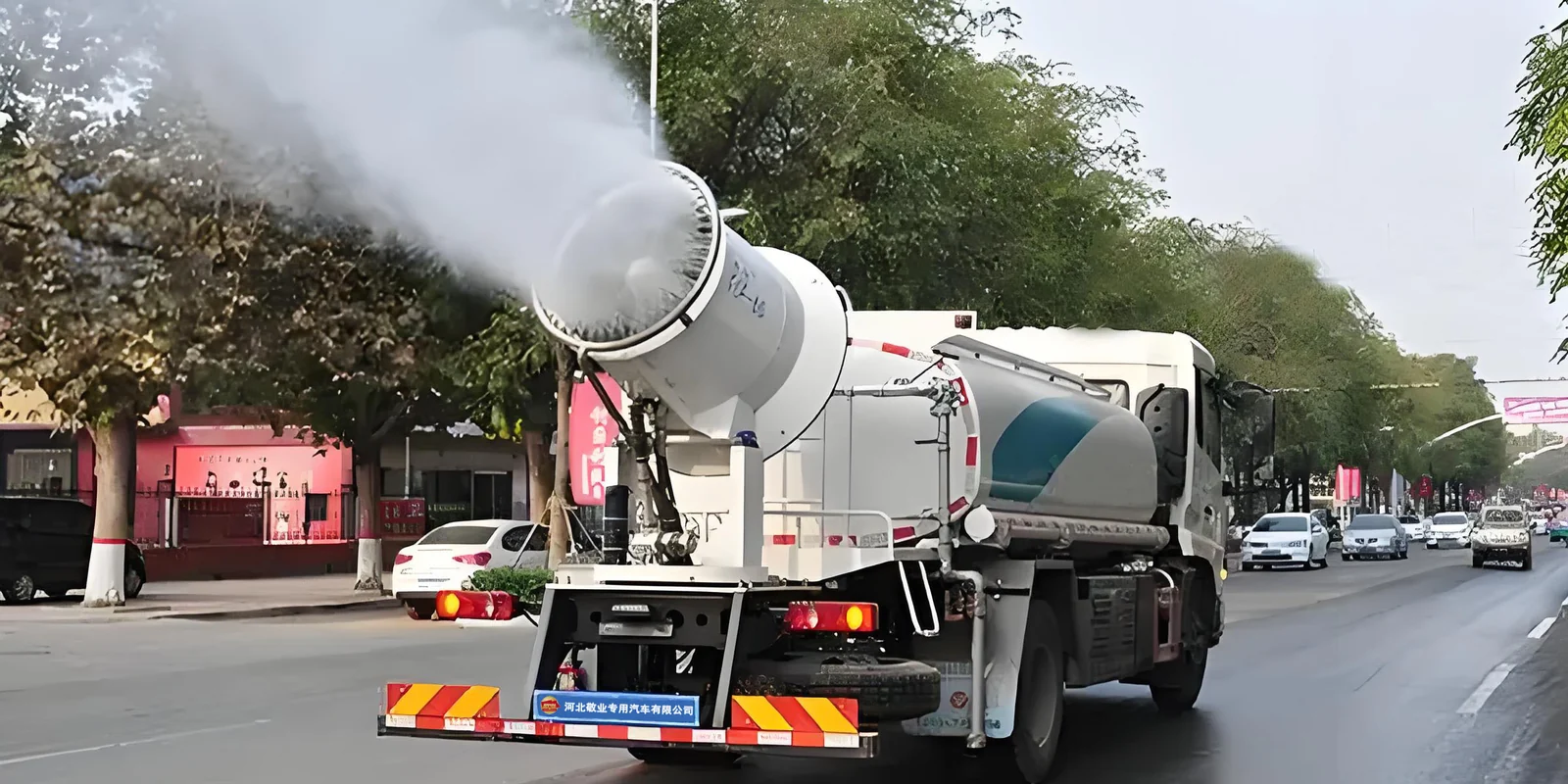
Suppression is not washing. The mechanism is that a droplet of roughly the same size as an airborne dust particle collides with it, and the two fall together. Droplets much larger than the particle push air around it and miss.
That is why a cannon is not simply a pump with a long throw. The nozzle ring and the fan are matched to produce a droplet spectrum that captures rather than wets — which also means the water goes further, because you are not soaking the ground to suppress the air.
On this vehicle the plunger pump is rated 2.2 to 3 kW at 1.5 to 2.0 MPa, feeding the cannon from a 9.7 m³ tank.
A 24 kW generator set drives the cannon.
Two spray modes run alongside it on the same vehicle: an 18 m forward jet for the road ahead, and a 10 m rear spray for the surface behind. Between them the vehicle can lay water on the haul road it is driving along while the cannon works the air above it.
A sprinkler bar wets the ground. A cannon treats the air. They solve different halves of a dust problem and a site with a real problem usually needs both.
Sprinkler bar. Cheap, simple, high throughput on a haul road. It stops dust being lifted in the first place, which is the most efficient place to stop it. It does nothing about dust already airborne, and it stops working as soon as the surface dries.
Cannon. Reaches dust that is already in the air, at a working face where there is no surface to wet — a crusher discharge, a demolition front, a tipping point. It covers a smaller area per hour and uses less water doing it.
If your dust comes off a road, start with the bar. If it comes off a process, you need the cannon.
| Mist cannon | 30–60 m throw, 3–5 m plume |
|---|---|
| Cannon drive | 24 kW generator set |
| Forward jet | 18 m |
| Rear spray | 10 m |
| High-throw | 40–60 m |
| Tank capacity | 9.7 m³ |
| Pump | Plunger, 2.2–3 kW, 1.5–2.0 MPa |