Fixed spray systems, chemical additives, water trucks and mist cannon trucks each solve a different dust problem. Which one fits your site, and why it does.
A fixed suppression system is nozzles, pipework and a pump installed at the dust source and left there — over a crusher, along a conveyor, around a transfer point.
Where it wins is repeatability. The dust comes off the same place every shift, so the treatment goes to the same place every shift, automatically, with nobody driving anything. Running cost per tonne treated is the lowest of any method once it is installed.
Where it loses is anywhere the source moves. A demolition front, an active tipping area, a haul road — all of them are somewhere different next month, and a fixed system installed for last month's layout is scrap.
Additives change the water rather than the equipment. Surfactants make each droplet wet dust more effectively; binders and stabilisers hold the road surface together so that dust is not lifted in the first place.
On a haul road with a long life, stabiliser is often the cheapest answer available, because it attacks the problem at the source and lasts weeks rather than hours.
The constraints are real and worth stating: additives cost money per litre, some are restricted near watercourses or agricultural land, and none of them do anything about dust that is already airborne from a process rather than a surface.
A water truck with a spray bar is the workhorse. It wets the haul road, it does it fast, and it goes wherever the road goes.
Its limits are the two you would expect. Coverage lasts until the surface dries, which in hot, dry conditions can be under an hour. And it does nothing for dust generated by a process rather than by traffic.
For most sites this is the baseline, and the question is what to add to it rather than what to replace it with.
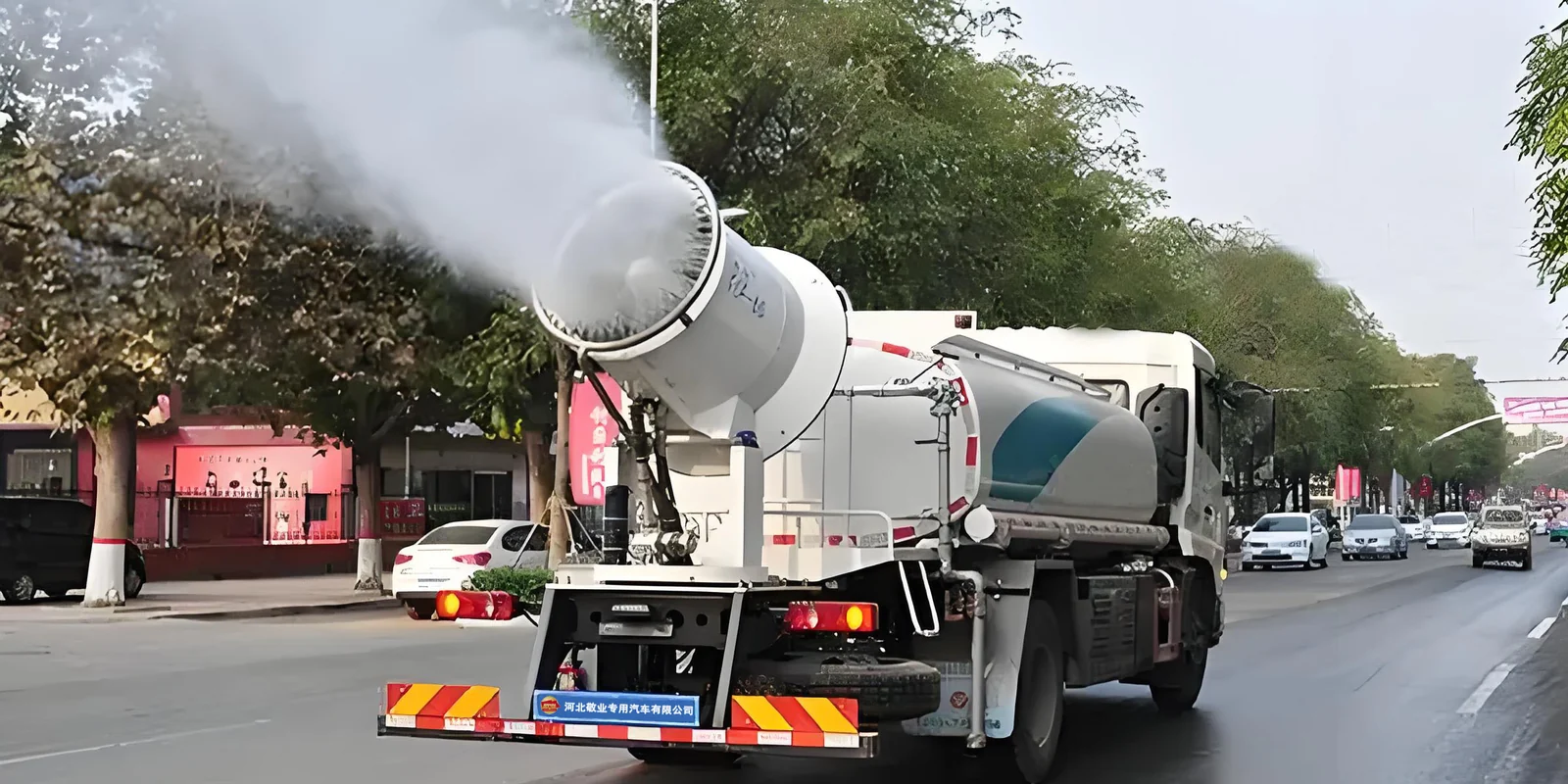
A mist cannon truck puts the treatment where the dust already is: in the air, at the face, at a distance that keeps the vehicle out of the cloud.
That is the one thing none of the other three methods do. A fixed system cannot follow a moving front; a stabiliser cannot capture what a crusher has already thrown into the air; a spray bar treats the ground beneath the problem rather than the problem.
On an enclosed or semi-enclosed site the case gets stronger, because the dust has nowhere to disperse to — and a battery-electric unit can work inside a structure where a diesel one is either restricted or prohibited outright.
Four questions in order:
Is the dust source fixed or moving? Fixed favours an installed system; moving needs a vehicle.
Is the dust coming off a surface or out of a process? A surface wants water or stabiliser on the ground; a process wants a cannon in the air.
How much of the shift is the machine standing still? A suppression vehicle that spends most of its day stationary is where an electric drivetrain pays back hardest, because an idling diesel burns fuel whether or not it is spraying.
What is the site's own compliance position? Low-emission zones, tender clauses that weight new-energy vehicles, and operator emissions targets are all live in these markets, and they change the arithmetic before anyone looks at running cost.