Site damping, compaction water and off-grid delivery on unpaved ground: matching tank, chassis and pump to the gradient, the water source and the shift pattern.
Everything about a water tanker changes when it leaves the tarmac.
On a made road the vehicle is a tank on wheels and the specification is about what comes out of it. Off the road it is a heavy vehicle on a surface that was not built for it, and the specification is about whether it gets there at all — loaded, in the wet, on a gradient, several times a shift.
Two consequences follow. Ground clearance and approach angles start to matter more than tank volume. And a full tank behaves differently from a full trailer of dry goods, because liquid moves: a partly filled tank on a side slope shifts its own centre of gravity as you drive.
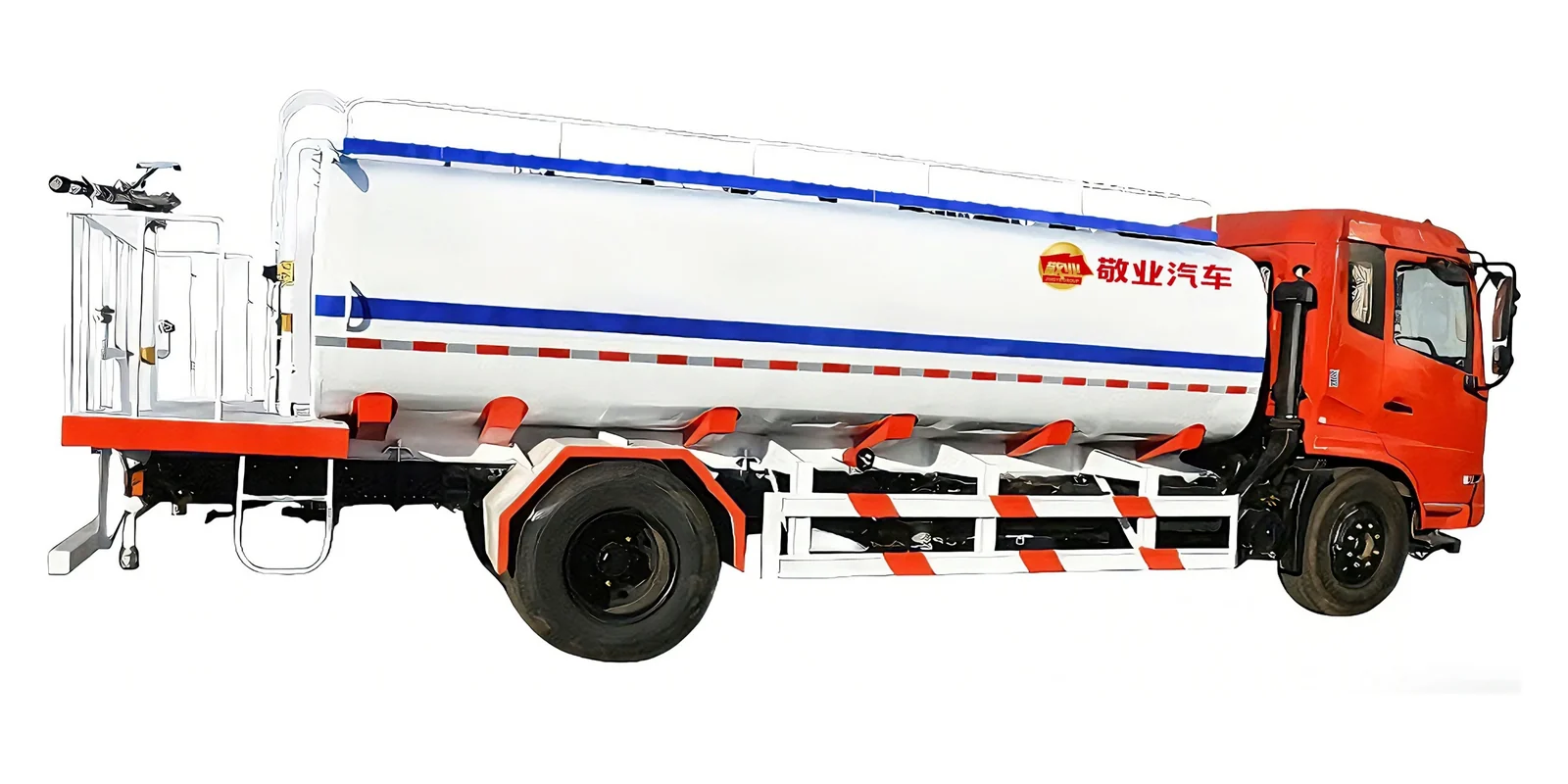
Gradient is the constraint that catches people out, because it is not on the specification sheet of anything.
A chassis that handles a site perfectly well when the surface is dry and the gradient is gentle will struggle loaded on a wet 1-in-8. What decides it is drive configuration, axle loading and tyres — and some sites need a configuration worth working out together before anything is quoted.
Tell us the worst gradient the vehicle has to climb loaded, and the state of the surface when it does.
Off-grid supply usually means one of three sources, and each one changes the pump.
A river or dam draw needs self-priming suction with enough lift for the bank, plus strainers sized for what is actually in the water rather than what you hope is.
A borehole delivers at whatever the pump at the bottom gives you, which is often slow. Fill time then becomes the constraint on output.
Transfer from a static tank is the simplest, and turns the vehicle into a distribution unit rather than a collection one.
None of these is a detail. Fill time is frequently the real limit on how much water a site gets per shift.
Two site duties look similar and are not.
Compaction water is a construction process. Fill material has an optimum moisture content, and reaching it is what lets the roller achieve the density the specification calls for. Too dry and it will not compact; too wet and it never will. The vehicle is placing a measured quantity of water, and evenness matters more than volume.
Site damping is dust control. The aim is to keep the surface from lifting under traffic, and it is repeated as often as the surface dries.
The same vehicle can do both, but the spray arrangement that gives you even placement for compaction is not the same as the one that gives you fast coverage for damping. If you need both, say so.
The surface and the worst gradient. Where the water comes from and how long a fill takes. What the water is for — compaction, damping, washing or delivery. How many working hours between refills you need to cover. And the destination country, so we can confirm what is required to register the vehicle there.