Battery-electric dust suppression truck with a mist cannon throwing 30 to 60 m and a 9.7 m3 tank. No engine idling at the working face.
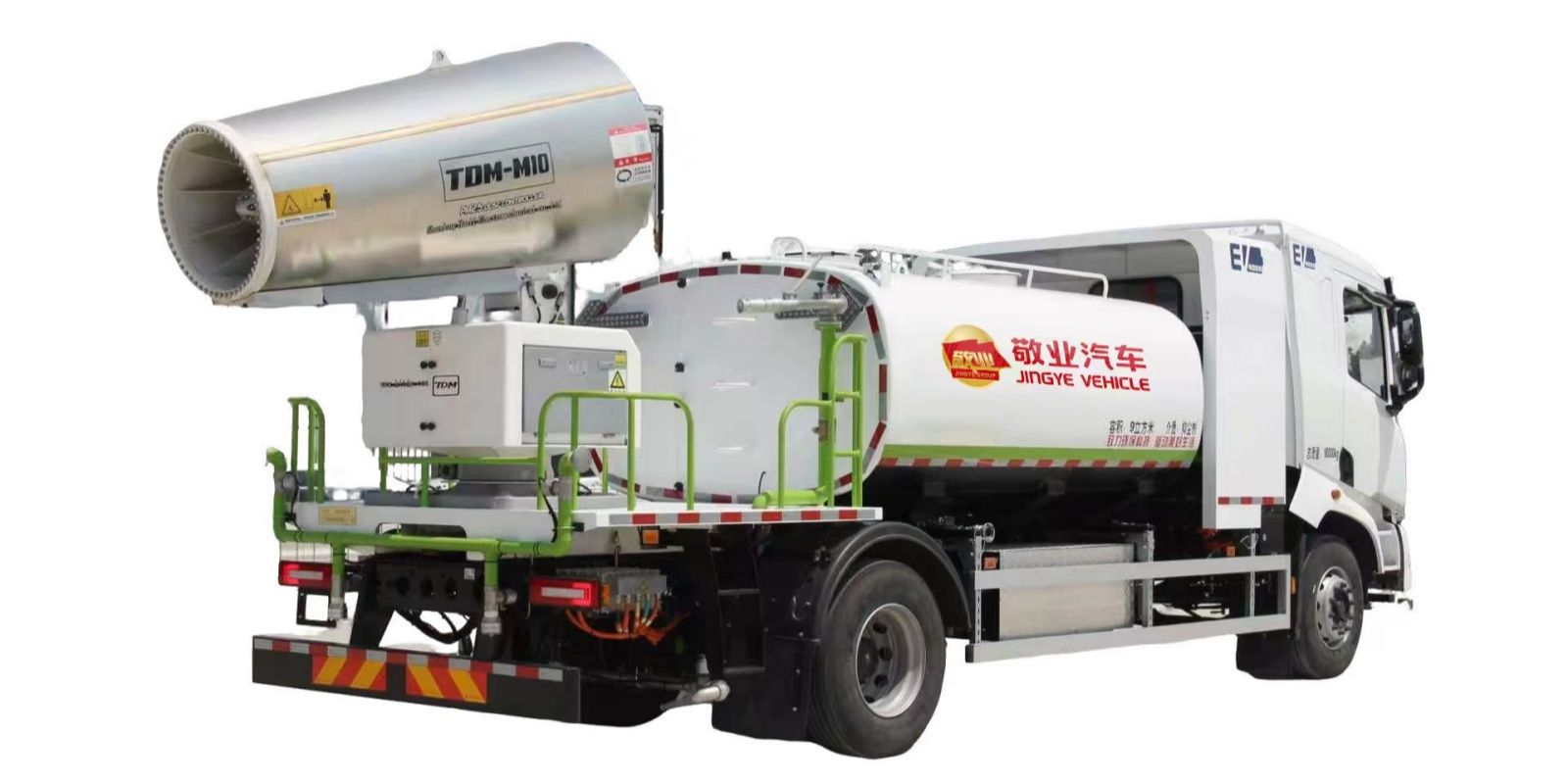
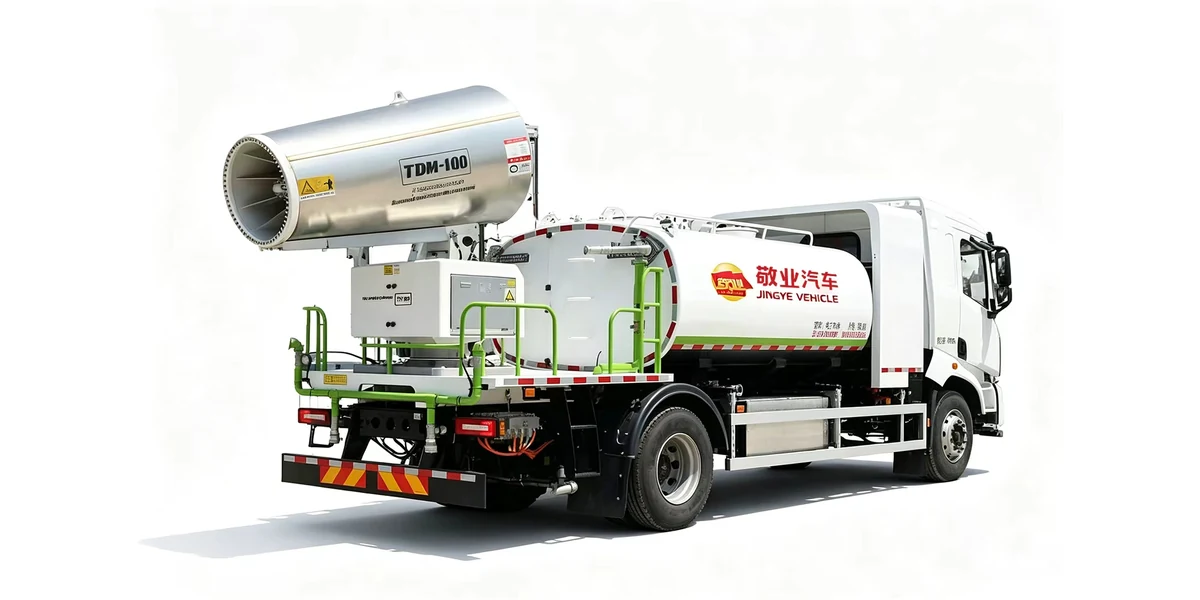
The cannon throws water 30 to 60 m as a mist, opening to a 3 to 5 m plume. That range is the whole argument for a cannon over a sprinkler bar: you knock down airborne dust across a working face without driving into it. A 24 kW generator set drives the cannon.
Three more spray modes are on the same vehicle: a 18 m forward jet for the road ahead, 10 m rear spray for the surface behind, and a 40 to 60 m high-throw for stockpiles and screening plant.
A suppression truck spends its shift standing still or crawling. That is the awkward truth about the diesel version: the engine runs all day to drive the pump and the cannon, and it runs it at the working face — which is exactly where people are breathing the dust you were sent to suppress. Putting a diesel exhaust next to the dust problem has always been a compromise.
This vehicle is built on a BYD battery-electric chassis (BYD1180C2BEVC1). What that changes, in the order buyers actually care about:
1. No engine idling where the work happens. The cannon runs without an engine turning over beside it. On enclosed and semi-enclosed sites — tunnels, covered stockyards, demolition inside a structure, underground haulage — that is not a preference, it is often the only way the vehicle is allowed in at all.
2. It is quiet enough to work at night. Municipal dust and washing work is pushed to night shift precisely because traffic is light. A diesel unit doing that in a residential district generates complaints; an electric one generally does not.
3. Standing still costs almost nothing. An idling diesel burns fuel whether or not it is spraying. An electric drivetrain draws power for the work it does. On a duty cycle that is mostly stationary, that gap is the running-cost case.
4. It scores where electrification is being scored. Low-emission zones, municipal tenders that weight new-energy vehicles, and mine operators with their own emissions targets are all live in our buyers’ markets. If your tender has a clause about it, this is the vehicle that answers it.
5. The chassis is a name your workshop knows. BYD, not an unbranded conversion. Ask us for the chassis documentation and we will send it.
We publish what we have been given: the chassis model and the vehicle’s rated weights. Battery capacity and working range are specified per order with the chassis supplier — we would rather route that question to a real number for your duty cycle than print a headline figure here.
A 9.7 m3 tank, a plunger pump rated 2.2 to 3 kW at 1.5 to 2.0 MPa, on a two-axle chassis at 18 t gross. 8.56 m long overall, which keeps it turnable inside a working site rather than only on the access road.
| Model | PJY5180TYCBEV |
|---|---|
| Chassis | BYD1180C2BEVC1, battery-electric |
| Overall dimensions | 8560 × 2500 × 3100 mm |
| Tare weight (manufacturer’s stated) | 7170 kg |
| Rated payload | 10700 kg |
| Gross vehicle weight | 18000 kg |
| Axles | 2 |
| Tank capacity | 9.7 m3 |
| Pump | Plunger, 2.2–3 kW, 1.5–2.0 MPa |
| Mist cannon | 30–60 m throw, 3–5 m plume, 24 kW generator set |
| Forward jet | 18 m |
| Rear spray | 10 m |
| High-throw | 40–60 m |
Buyers arrive at this vehicle under four different names, and the names are worth untangling before you compare quotations.
A dust suppression truck is the whole vehicle: chassis, tank, pump and cannon, built to work as one unit. A mist cannon truck and a truck mounted mist cannon are the same vehicle named after the part people notice first. A fog cannon truck is the same thing again, with “fog” doing the work that “mist” does elsewhere.
What none of those names covers is a cannon on its own — a skid-mounted or trailer-mounted unit that has to be positioned, plumbed and fed. That is a different purchase with a different job, and it is the reason a quotation for “a mist cannon” and a quotation for this vehicle can differ by an order of magnitude.
If what you need is the cannon itself rather than a vehicle around it, the spoke page covers throw distance, flow rate and what the generator set drives.
Tell us the site and the duty cycle. Ask us for the chassis documentation and we will send it.