





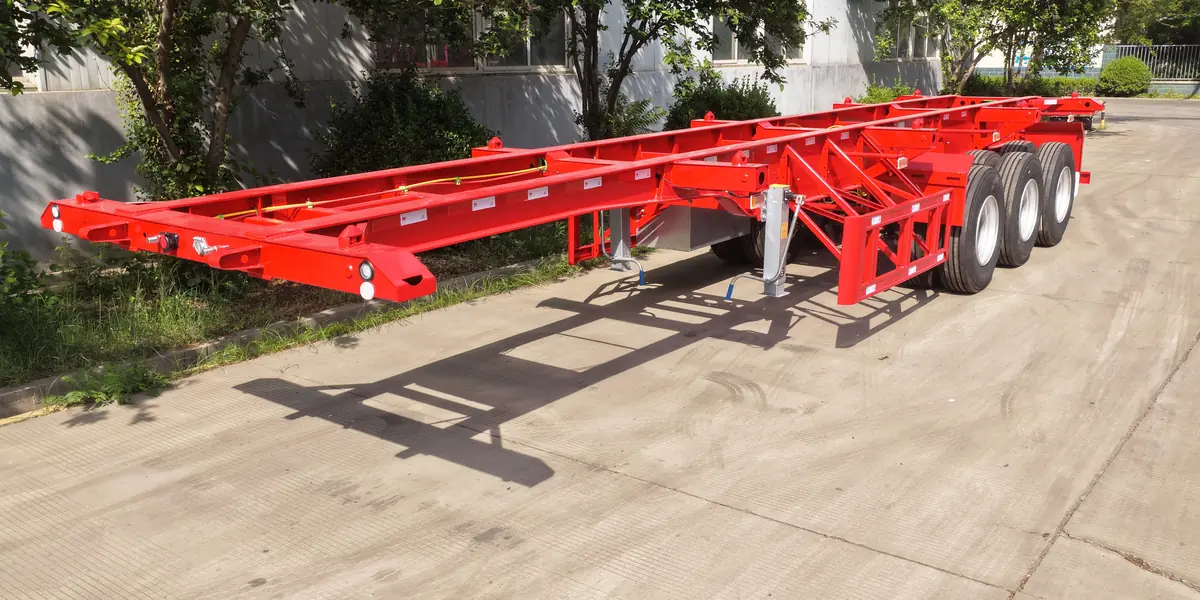
A container chassis is a semi trailer built for one job: carrying a shipping container between the port, the rail yard, the depot and the customer’s gate. It has no deck and no sides of its own. The container itself becomes the load space, and the chassis gives it wheels, brakes and a connection to the tractor.
If you are buying chassis for a port fleet, a haulage contract or a distribution business, the specification comes down to three things: the boxes you carry, the frame shape your routes allow, and the fifth-wheel height of your tractors.
How a container chassis differs from a flatbed
A flatbed semi trailer has a full deck. It carries steel, machinery and general cargo, and some flatbeds have twist locks fitted into the deck so they can take a container as well. A container chassis drops the deck entirely. What is left is a frame of main beams and cross members, with twist locks at the points where a container’s corner castings sit.
That stripped-back design is why many operators call it a skeletal trailer or a skeleton trailer. With no deck to carry, it is a lighter, purpose-built vehicle.
But a chassis carries containers and nothing else. If containers are most of what you move, a dedicated chassis is usually the better vehicle to run; if they are only an occasional load, a flatbed with twist locks may suit you better.
Twist locks: the part that holds the box
A shipping container is designed to be held at its corner castings, one at each corner. On a chassis, a twist lock rises into each bottom corner casting and is turned to lock the box down.
One 20 ft box sits on four locks. One 40 ft box also sits on four locks, set further apart. Two 20 ft boxes end to end need locks at the 20 ft positions as well.
So the number and position of locks decide which boxes a chassis can carry. This is the first thing to settle before you ask for a quote.
Matching lock count to your box plan
Lock count and frame length are two decisions, not one. The frame carries the box; the locks decide which boxes it can carry. On the chassis we build, lock count maps to the box plan like this:
| Twist locks | Boxes carried |
|---|---|
| 4 | 1 × 40 ft |
| 6 | 1 × 40 ft |
| 8 | 1 × 40 ft or 2 × 20 ft |
| 12 | 1 × 40 ft or 2 × 20 ft |
Twelve locks does not mean twelve boxes. It means twelve positions, so one frame covers several box plans without a second trailer. The extra positions add weight you carry on every trip, so they earn their place only if your traffic actually varies.
Tell your supplier what your box mix looks like over a typical month, including the boxes you move only occasionally.

20 ft and 40 ft frames
A frame built around a single 20 ft box is the shortest and lightest chassis. It suits operators whose traffic is genuinely all short boxes, such as heavy commodities where a 20 ft box reaches its weight limit long before its volume limit, or short-haul terminal work where manoeuvrability matters more than capacity.
The catch is that it cannot take a 40 ft box at all.
A 40 ft frame with eight or twelve lock positions is the general-purpose choice, because it takes one 40 ft box or two 20 ft boxes on the same vehicle. It weighs a little more than a dedicated 20 ft frame, and earns that back the first time a mixed load would otherwise have needed a second trailer.
For the frame options we build, see our container chassis sizes page.
Gooseneck or straight frame
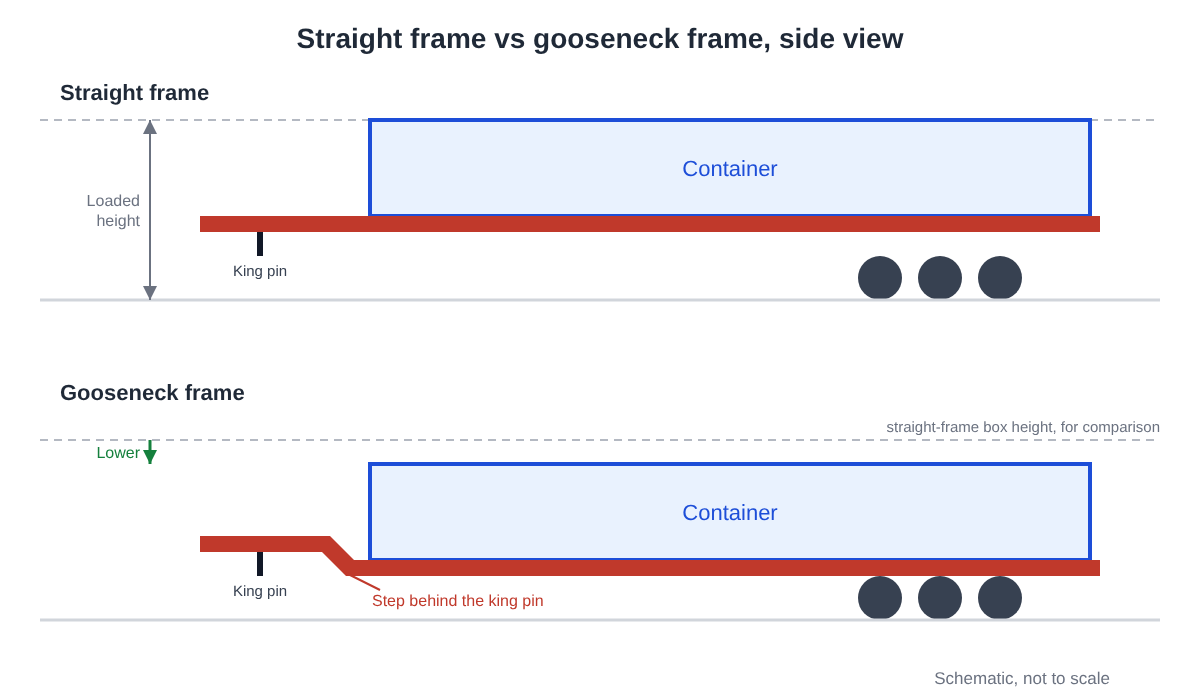
Look at a container chassis from the side and you will see one of two shapes. A straight frame runs level from the king pin to the rear. A gooseneck frame steps the main beam down behind the king pin, so the part of the frame that carries the box sits lower than the fifth wheel.
That step lowers the loaded height, which is what decides whether you clear a terminal ramp, a bridge on the approach road or a height limit in a permit. It matters most when you carry taller boxes or run close to a height limit.
A straight frame is simpler to build and sits the box a little higher and level, which suits routes with headroom, flat terminals, and handling equipment that wants the corner castings up rather than down.
The choice depends on two numbers: your tractor’s fifth-wheel height and the tightest clearance on your regular route. We go into more detail on our gooseneck and straight frame chassis page.
Fifth-wheel height
The front of the chassis rests on your tractor’s fifth wheel. Fifth-wheel height plus frame shape gives you the height of the frame under the box; that plus the box height gives you the loaded height that has to clear everything on your route.
Get the pairing wrong and you can end up with a road-legal trailer that cannot use half your network. Measure the fifth-wheel height of the tractors that will pull the chassis, and include it in your enquiry.
What to tell a manufacturer before you order
Before you contact any chassis builder, have answers to these:
- Your box mix: 20 ft, 40 ft or both, and roughly how often each.
- Two 20s or not: do you ever need to carry two 20 ft boxes at once?
- Fifth-wheel height of the tractors you will use.
- Your route: the tightest height clearance, and the axle load and gross weight limits in the countries you operate in.
- Quantity: one unit for a trial, or a fleet order.
With these five answers, a manufacturer can propose a lock layout, frame length and frame shape that fit your work.
A note on terms
A container chassis and a shipping container are two different things. The chassis is the trailer. The shipping container is the steel box it carries. If you are looking for the boxes themselves, see our shipping container page instead.
Tell us your box plan
If you are planning a chassis order, send us your box mix and your tractor’s fifth-wheel height, and we will come back with a configuration to match. See our container chassis range, or contact us. Our engineers reply within 24 hours.
Email: info@jy-trailer.com
WhatsApp: Manager Tan +86 150 2773 4701 · Manager Zhang +86 185 0327 0573 · Manager Liu +86 189 2375 2006 · Manager Peng +86 185 3334 5708
HEBEI JINGYE SPECIAL VEHICLE CO., LTD.