How loads are secured on a flatbed semi trailer: lashing points, twist-lock positions for containers, coil cradles, and what to specify before you order.
A flat deck holds nothing by itself. Everything that keeps a load on the trailer is either bolted to the frame or thrown over the top of the cargo, and the two are not equally good.
Lashing points welded or bolted into the main beam take load into the structure. Points fixed only to the deck plate take it into a sheet of steel that was never meant to carry a lateral pull. That distinction does not show up in a photograph and it does not show up in a price, but it shows up on a bad road.
Ask two questions of any platform trailer you are quoting: where are the lashing points anchored, and how many are there per metre of deck. The second one is what decides whether you can rig a load properly or have to improvise around the points you were given.
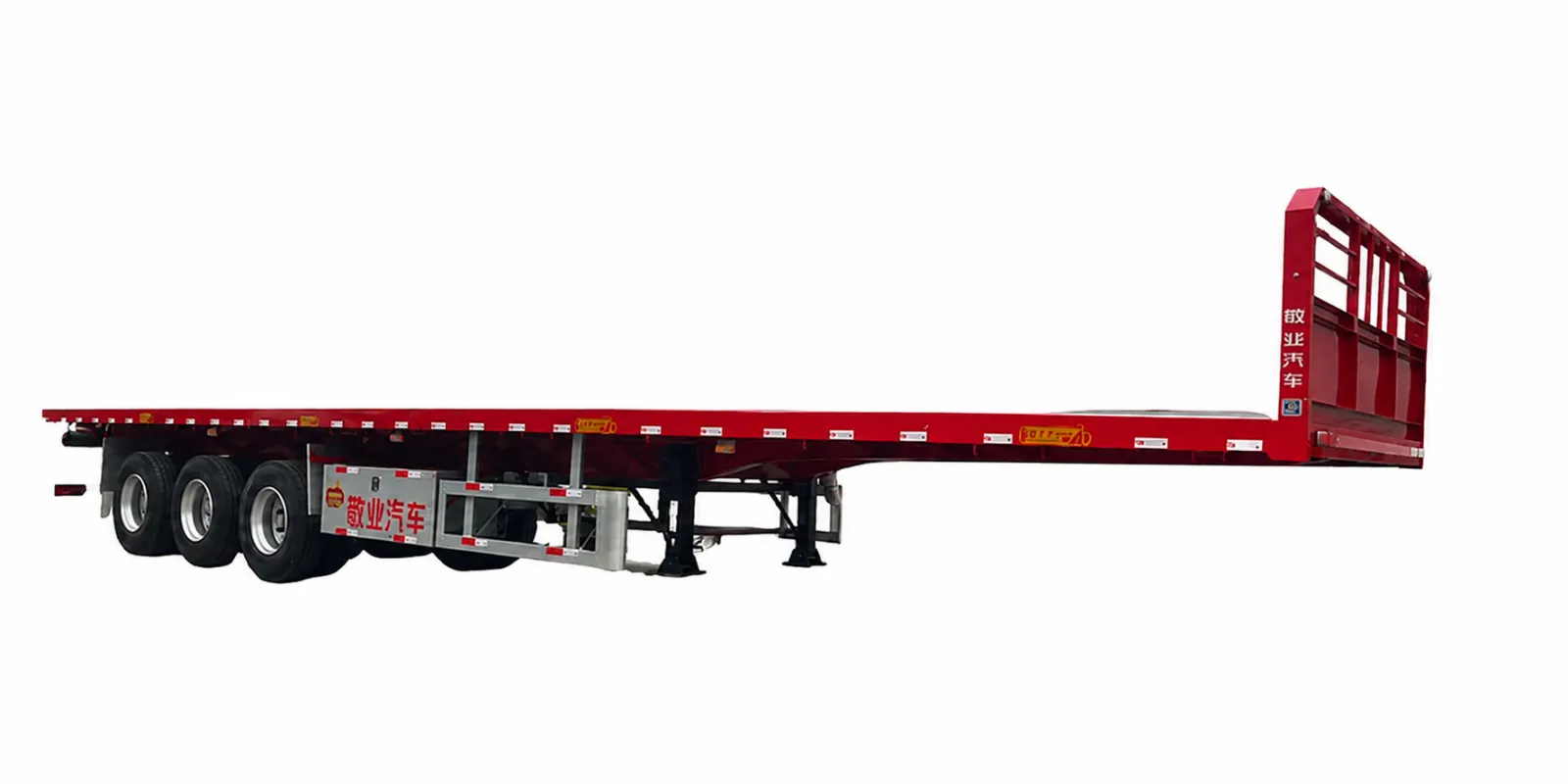
A platform trailer will carry a container, and a great many of them do. What matters is how.
Twist locks fitted into the deck hold the box at its corner castings, which is where a container is designed to be held. Strapping a box down over the top instead puts the load into the roof rails and the door frame, neither of which is a lifting or restraint point. If containers are a regular part of your work rather than an occasional one, the twist-lock positions have to match your box plan before anything else about the trailer matters.
If containers are most of what you move, the dedicated chassis is the cheaper vehicle to run — lighter, purpose-built, and specified by lock count rather than by deck length.
Coil is the load that catches people out. It is heavy, it is round, and it concentrates its entire mass into a footprint smaller than a doormat.
Two numbers govern whether a flat deck can take it. The first is the concentrated load rating — not the payload. A trailer rated for 34 t spread over 13 m may be nowhere near able to take 27 t sitting on half a metre of deck. The second is what stops it rolling. A coil that starts to move at speed does not stop at the headboard; it goes through it.
On a flat deck that means cradles or chocks plus proper restraint. If coil is your main traffic rather than an occasional load, a recessed well takes the coil down into the frame and does the job structurally instead of with straps.
Longer is not better. Deck length decides where the weight sits relative to the axles, and a load placed too far back on a long deck can be legal on paper and unpleasant to drive.
Pick the deck for the load you carry most often, not the largest one you have ever carried. A 13 m platform is the general-purpose answer. A 12.4 m container-oriented deck suits operators whose work is mostly boxes. A short deck suits dense cargo that would otherwise leave most of the platform empty and the weight in the wrong place.
Tell us three things — what you carry, how it is loaded, and what the road is like — and we will tell you which deck and which lashing arrangement fits, including when the answer is that a platform trailer is the wrong vehicle for the job.