Choosing a tipper for a haul road: body length, discharge angle, cylinder package and how material density and ground conditions change the specification.
A haul road is not a road. It is a working surface that changes shape every week, under a vehicle that runs to its limit loaded and empty in the other direction, tipping several times a shift.
What fails on that duty is rarely the body. It is the frame, and usually at the point where the tipping loads come back into it. A body wears out gradually and visibly; a frame cracks at a stress concentration you cannot see until it has propagated.
That is why the useful question about a tipper is not how thick the floor is. It is what the frame is made of, where it was welded, and whether it was designed around the discharge cycle or adapted to it afterwards.
Two tippers with the same body volume can be entirely different vehicles, because density decides how full you can actually load.
Light material fills the body and never reaches the axle limit; dense material reaches the limit with the body half empty. Both are normal, and each wants a different specification. Density also decides the cylinder package: lifting a body full of wet ore is a different job from lifting the same body full of dry aggregate, and a cylinder set sized for the second will not give you the service life you expected on the first.
We size the cylinder package to the actual duty rather than shipping one standard set. Tell us the material and its typical moisture state, and the answer follows.
The choice is decided by two things: the material, and the ground you discharge onto.
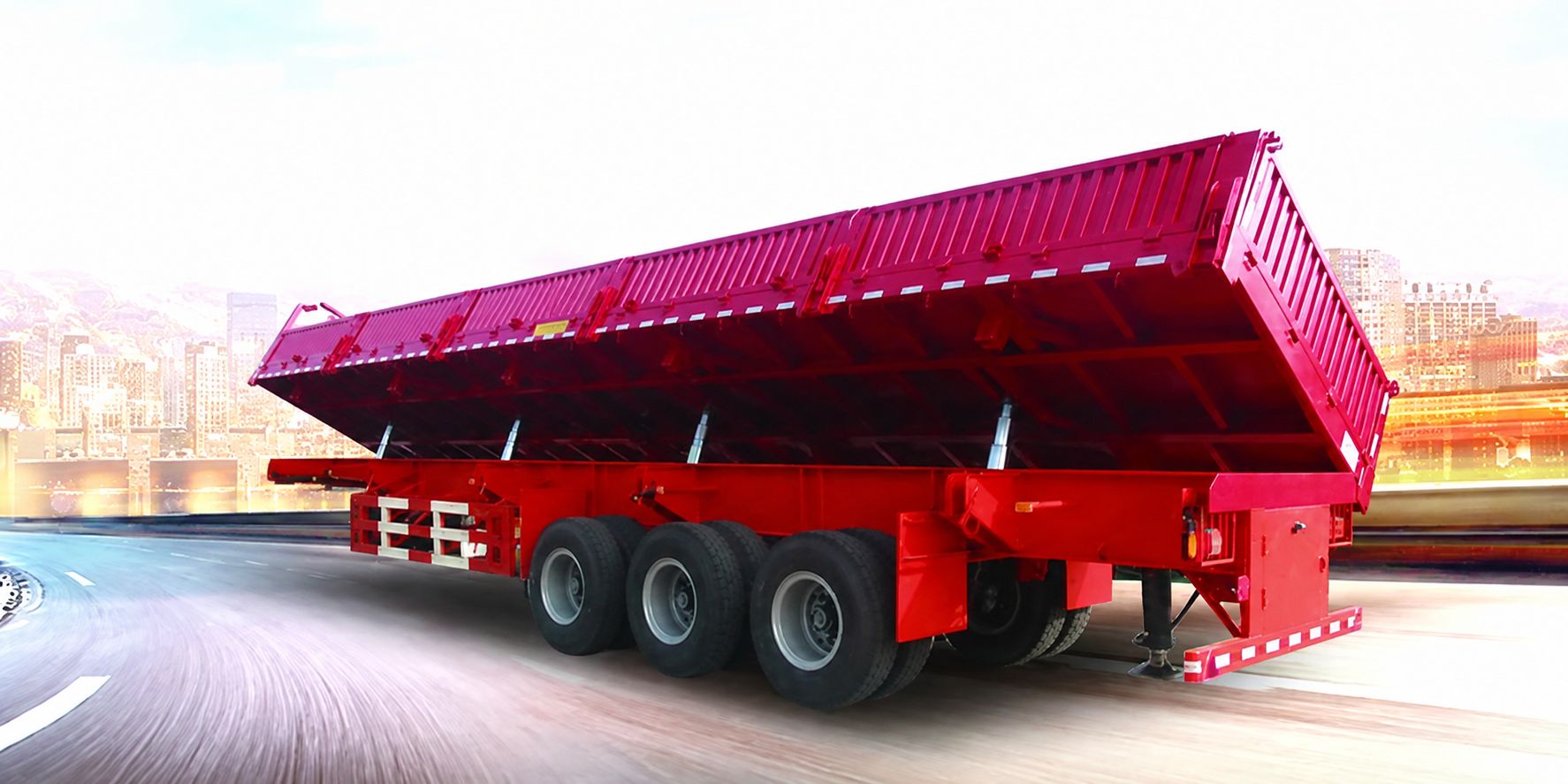
Side tipping discharges across the width of the vehicle. It is fast, it suits free-running material, and it wants ground that is level enough to tip safely across the axis of the trailer. On a well-maintained haul road with dry aggregate, it is the higher-throughput answer.
Rear tipping discharges over the tail. A shorter, taller body at a steeper angle clears material that sticks — wet sand, clay-bound aggregate, anything that will hold onto a long floor. It also tips on ground where a side tip would be uncomfortable, because the vehicle stays in line with its own axis.
If your material sticks, or your ground is uneven, ask about the rear tipper before you assume the side tipper is the default.
Two sentences from you settle most of the specification: what you are hauling and in what condition, and what the road is like at its worst. Everything else — body volume, cylinder package, suspension, discharge angle — follows from those two.