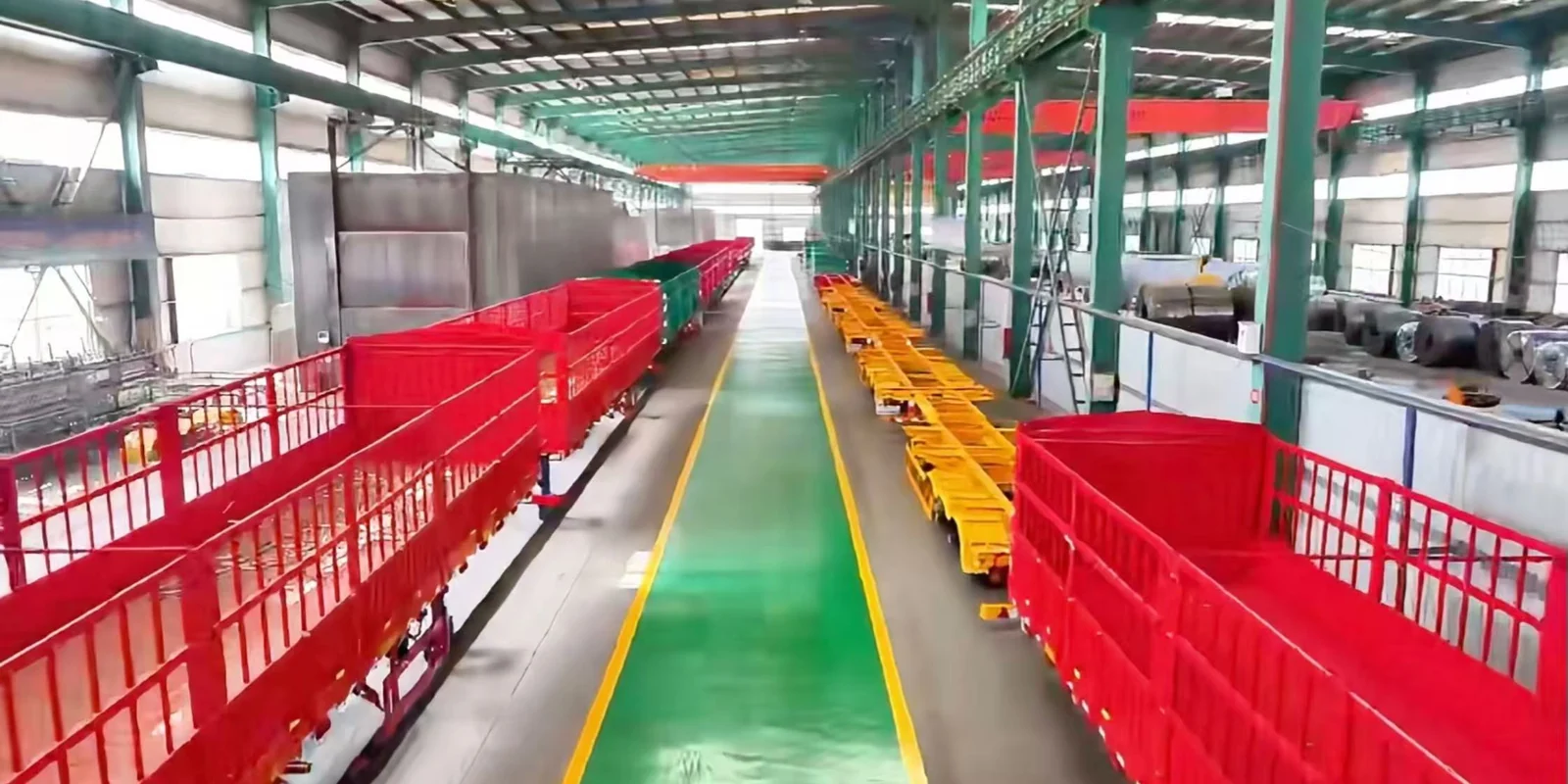
The line that makes our 20 ft boxes: panel forming, frame welding, coating and the CSC survey — filmed on the floor, with the throughput we actually run.
A container starts as flat weathering steel plate and becomes a box in two operations.
Forming puts the corrugation into the side and end panels. The corrugation is what makes a thin panel stiff enough to be a structural wall — the profile is doing the work, and the depth and pitch are fixed rather than decorative.
Welding joins the panels to the frame: corner posts, top and bottom rails, and the eight corner castings. The frame carries the stacking loads, and a container in a stack has several loaded boxes above it. Every one of those loads goes through the corner posts and castings, not through the walls.
This is where a box is either square or is not, and a box that is not square never becomes square afterwards.
Coating is applied over prepared steel, and the preparation is where most of the durability comes from. A good coating over a poorly prepared surface fails at the interface no matter what it cost.
The system is a primer plus a topcoat, on a surface cleaned to remove mill scale and contamination. Weathering steel underneath is what keeps the box going after the coating is eventually compromised — as on a working container it will be.
We do not publish a salt-spray hour figure for this line. If your specification calls for a stated salt-spray performance, ask — we will tell you what we can evidence for the coating system you are being quoted.
The floor is 28 mm. It is the component that takes a forklift working inside the box, and it is the one most often thinned to save cost — and the one that fails first when it is.
The corner castings are the only points on a container that anything is permitted to lift, lash or lock onto. Every crane spreader, every twistlock, every lashing point in the world is built to their dimensions, which is why the tolerances are fixed by standard rather than by preference.
Fitting them accurately is not a finishing operation. If the castings are out of position the box will not lock down on a chassis or stack correctly on a ship, and there is no field repair for that.
Before a box leaves it is surveyed and a CSC Safety Approval Plate is fitted. The plate carries the approval reference, the maximum gross and tare weights, and the next examination date.
Without a valid plate a container cannot legally move in international transport. It is not a marketing badge; it is the document that lets the box travel.
Twenty minutes on camera settles what a specification sheet cannot: whether there is a line, whether it is running, and whether the boxes coming off it look like the one you were shown.
Pick a time zone and we will walk it — forming, welding, coating, floor, survey.